
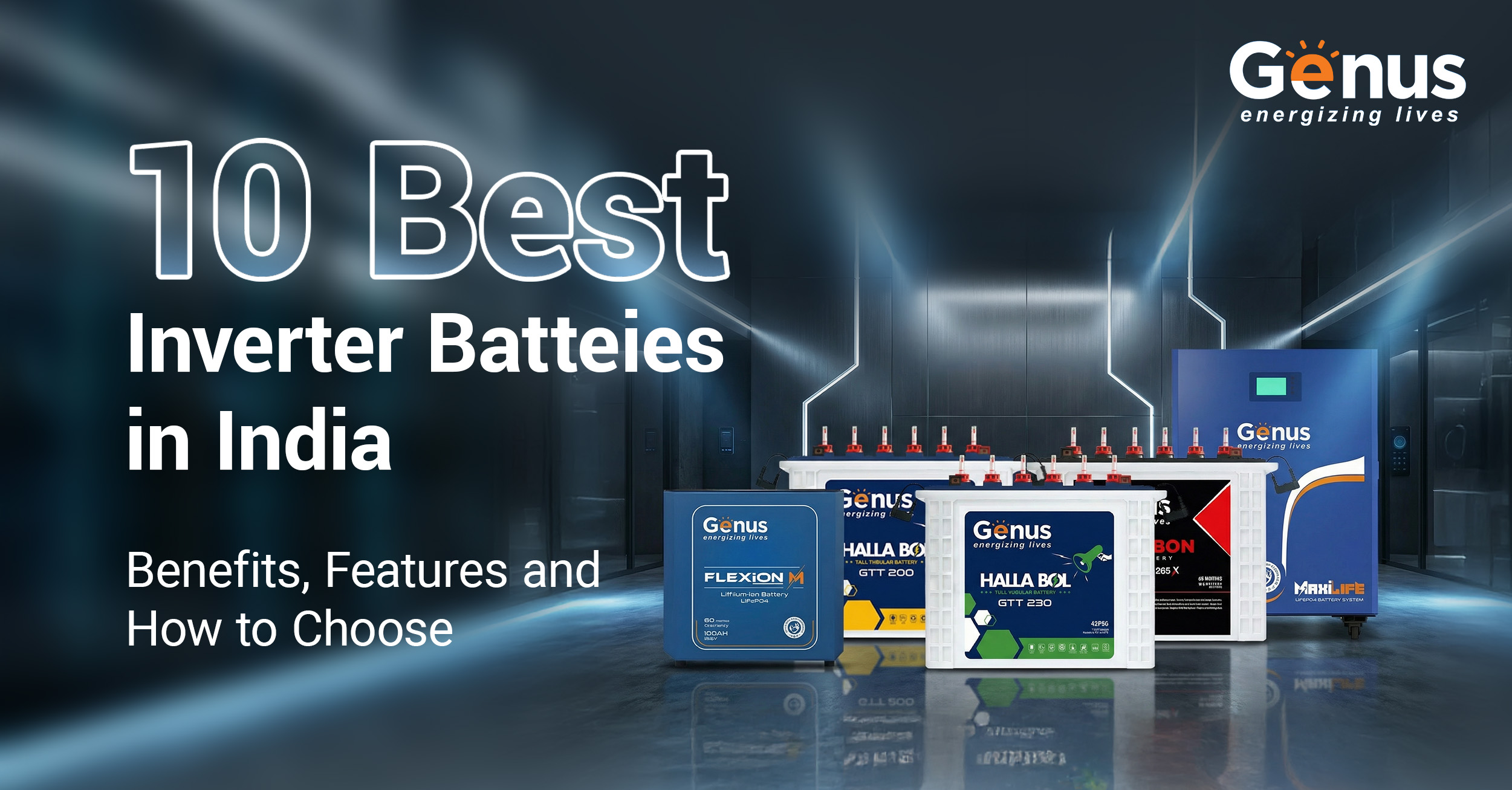
If you are looking for a reliable power backup solution for your home or office, choosing the right inverter battery is just as important as selecting the inverter itself. A good battery ensures longer backup, better performance during power cuts, and lower maintenance over time.
Genus is one of India’s most trusted power and energy brands, offering a wide range of lithium-ion and lead-acid tubular inverter batteries designed for different usage needs-from daily power cuts in urban homes to heavy-load requirements in offices and commercial spaces.
In this guide, we explore the 10 best Genus inverter batteries, their key benefits, and how to choose the right one for your specific requirements.
What to look for in an inverter battery?
Before choosing an inverter battery, consider these essential factors:
- Capacity (measured in Ah or Wh): Higher capacity means longer backup time
- Battery type: Lithium-ion (maintenance-free, long life) vs Lead-acid tubular (cost-effective, robust)
- Compatibility: Must match your inverter or solar system specifications
- Warranty & battery life: Longer warranty usually indicated better reliability
- Charging speed: Important for areas with frequent power cuts.
Types of inverter batteries
- Lithium-ion batteries: Compact, fast-charging, maintenance-free and long-lasting
- Lead-acid tubular batteries: Economical, proven technology, suitable for long-duration power cuts
Lead Acid Battery vs Lithium-Ion Battery
When choosing the best inverter battery, understanding the difference between lead-acid and lithium-ion batteries helps you make the right long-term decision.
Lead-acid batteries (like Genus Hallabol series) have been used in home inverters for decades. They are cost-effective, widely available and suitable for users who need long backup at a comparatively lower upfront cost. However, they require periodic maintenance such as water topping and take longer to charge.
Lead-acid battery works best if:
- Power cuts last several hours
- You are comfortable with basic maintenance
- You already own a compatible inverter
Lithium-ion batteries (like Genus MaxiLife and FLEXiON M) are a newer, advanced option. They are maintenance-free, charge faster, occupy less space, are free from acid fumes and offer significantly higher charge-discharge cycles. They often last much longer and perform better during frequent short power cuts.
Lithium-ion battery works best if:
- You want zero maintenance
- Space is limited
- Power cuts are frequent but short
- You want long battery life with minimal performance drop
For modern homes, lithium-ion batteries are increasingly becoming the preferred choice, while lead-acid batteries still remain relevant for high-capacity, budget-controlled setups.
In short:
- Choose lead-acid if budget is a priority and power cuts are long but less frequent.
- Choose lithium-ion if you want hassle-free ownership, compact size solution that is also free from harmful fumes and acid spills, offer fast charging and long life.
How to choose an inverter battery?
It is not just the right Ah rating that matters at the time of battery selection. There is more to it. So here are some of the most important factors that you should consider at the time of selecting inverter battery so that you can get a right fit for your inverter system.
Backup requirement
Calculate how long you want power backup during outages. Longer backup needs higher Ah or Wh capacity.
Loads in Watts
Make a list of appliances (fans, lights TV, router etc.) and their wattage. Backup time depends on total watt load and not just battery size.
Battery type
Make your choice between lithium-ion and lead-acid based on the maintenance preference, space availability and usage pattern.
Charging time
Areas with frequent short power cuts benefit more from fast-charging lithium batteries so you need to make the choice based on the power cut pattern of your area.
Warranty & brand reliability
It is very important to check the warranty period, service network and brand credibility always. Batteries are a long-term investment so you to be sure of your selection to enjoy hassle-free experience.
10 Best Inverter Batteries
Below are the best inverter batteries that you can check based on your requirements and select the one that can best serve with the desired load capacity, backup requirements etc.
Genus FLEXiON M
Flexible lithium-ion option for scalable systems:
- Battery type: LiFePO4 lithium-ion
- Capacity: 100Ah
- Best for: Inverters requiring efficient lithium backup
- Why it stands out: Solid lithium battery with long life and low maintenance
Great choice if you want lithium performance without integrated inverter- ideal for pairing with an existing unit.
Genus MaxiLife
- Battery type: LiFePO4, Lithium-ion
- Capacity: 100Ah
- Installation: Wall-mounted
- Best for: Modern homes having space constraints
- Why it stands out: Multi-layer protection for voltage, current & temperature
Perfect for first-time buyers and modern homes.
Genus Hallabol GTT230 180Ah
Reliable lead-acid option for everyday use:
- Battery Type: Lead-acid tubular
- Capacity: 180 Ah
- Best For: Home/office setups with moderate power cuts
- Why It Stands Out: Tall tubular design ensures consistent performance and deep discharge protection
It is a balanced choice with good capacity and dependable backup.
Genus Hallabol GTT240 150Ah
Compact and effective:
- Battery Type: Lead-acid tubular
- Capacity: 150 Ah
- Best For: Small to medium homes
- Why It Stands Out: Stable backup performance with easy installation.
It is an affordable yet reliable option for regular outages.
Genus Hallabol GTT250 220Ah
Heavy-duty backup at a competitive price:
- Battery Type: Lead-acid tubular
- Capacity: 220 Ah
- Best For: Large homes or commercial setups
- Why It Stands Out: Robust tall tubular construction for long cycle life and strong performance.
Ideal if you need extended backup without moving up to lithium.
Genus Hallabol GTT270 230Ah
Consistent performance for heavy usage:
- Battery Type: Lead-acid tubular
- Capacity: 230 Ah
- Best For: Extended home or small office usage
- Why It stands Out: Comes with a 72-month warranty and good deep discharge recovery for frequent outages.
Genus Hallabol GTT250
Versatile, long-lasting and fast-charging inverter/UPS battery
Battery type: Lead-acid tubular
Capacity: 220Ah
Best for: Commercial setups
Why it stands out: Factory charged so ready to use and works with any inverter
This is the best choice if you live in an area with long and frequent power cuts.
Genus Halalbol GTT270
Battery type: Lead-Acid tall tubular
Capacity: 230Ah
Best for: Big homes, offices and shops
Why it stands out: Offers higher backup and fast recharge
It is solar compatible so can work with solar setups as well.
Genus Halalbol GTT170 150Ah
Compact but powerful lead-acid battery:
- Battery Type: Lead-acid tubular
- Capacity: 150 Ah
- Best For: Smaller power backup needs
- Why It Stands Out: Eco-friendly recyclable design with reliable performance.
This is an excellent budget-friendly option if you’re looking for a basic yet sturdy battery.
Why Genus batteries serve as a good choice?
Genus inverter batteries are known for:
Long Life & Reliable Backup
Their tubular designs and lithium tech ensure consistent performance, even in frequent power cuts.
Low to Zero Maintenance
Lithium models require no maintenance, and tubular lead-acid batteries only need minimal upkeep.
Wide Range for All Needs
From small home use to heavy office backup, Genus has options across capacities and technologies.
Warranty & Support
Most models offer extended warranties (up to 72 months on some lead-acid batteries), giving peace of mind.
FAQs
Q. How to choose an inverter battery for home?
A. Choosing the right inverter battery for your home depends on your backup requirements, total load, power cut patterns and maintenance preferences.
To make this easier, we’ve put together a detailed guide that walks you through all the key factors – from capacity and battery type to warranty and performance – so you can pick the best fit for your household needs. Read the full article here: Which is the Best Inverter Battery for Home?
Q. What Battery Type Works Best with a Home Inverter?
A. The best battery type for a home inverter depends on how you use your system. Lithium-ion batteries are ideal for frequent short outages and require zero maintenance, while lead-acid tubular batteries are cost-effective for long-duration power cuts and higher capacities. Each has its advantages based on budget, space, and usage habits.
Q. How long does an inverter battery last for home use?
A. The lifespan of an inverter battery depends on its type, usage pattern and maintenance. Traditional batteries typically last 3-5 years with proper care, while lithium-ion batteries can last 8-10 years due to higher charge-discharge cycles and zero maintenance requirements.
Q. Are lithium-ion inverter batteries safe for home use?
A. Yes, modern lithium-ion inverter batteries, especially those using LiFePO4 technology, are designed with multiple safety protections against overcharging, overheating and short circuits. They are also free from acid leaks and fumes, making them safe for indoor installation.
Q. How much maintenance does an inverter battery require?
A. Lithium-ion inverter batteries require no maintenance at all, while lead-acid tubular batteries need periodic water topping and terminal checks. Choosing the right battery type can significantly reduce long-term maintenance effort.