
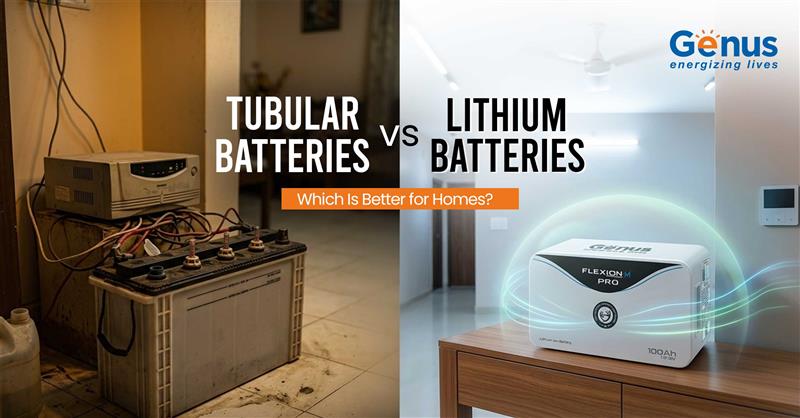
Choosing the right power backup solution has become more important than ever, especially with rising power cuts and increasing electricity dependence. When it comes to inverters, the biggest confusion home-owners face is tubular vs lithium battery-which one is better?
In this blog, we will compare tubular battery vs lithium-ion battery inverter based on performance, efficiency, maintenance, and long-term value. If you’re searching for the best inverter for home, this guide will help you make a smarter decision.
What is a Tubular Battery?
A tubular battery is a type of lead-acid battery commonly used in traditional inverter systems. It has been a popular choice for years due to its affordability and ability to provide decent backup.
Tubular batteries are designed with tubular plates that help improve durability and performance compared to flat plate batteries. However, they still require regular maintenance like water top-ups and proper ventilation.
Also Read: Things To Know Before Buying A Tubular Inverter Battery
What is a Lithium Battery?
A lithium battery inverter uses advanced lithium-ion technology to store and deliver power efficiently. These batteries are compact, fast-charging, and require zero maintenance, making them ideal for modern homes.
Lithium batteries are a key component of today’s energy storage systems (ESS), helping users store electricity and use it intelligently during power cuts or peak demand.
Also Read: From High Maintenance to Smart Power Backup: Why Upgrade to Lithium Battery Inverters
Tubular vs Lithium Battery: Key Differences
Here’s a clear comparison between tubular vs lithium-ion battery inverter to help you understand which suits your needs better:
| Feature | Tubular Battery Inverter | Lithium Battery Inverter |
| Efficiency | Moderate | High |
| Backup time | Good | Consistent |
| Charging speed | Slow charging | Fast charging |
| Maintenance | Regular maintenance needed | Zero maintenance |
| Space requirement | Bulky and heavy | Compact and space saving |
| Lifespan | Shorter lifespan | Longer lifespan |
Key Insight:
While tubular batteries may seem affordable initially, lithium battery inverters offer better performance, convenience, and long-term savings, making them a smarter choice for modern users.
Who is Lithium Battery Inverter For?
A lithium ion battery inverter is ideal for:
- Homeowners looking for the best inverter for home with zero maintenance
- People living in apartments or compact spaces
- Users who want fast charging and uninterrupted backup
- Those investing in energy storage systems (ESS) or solar solutions
- Tech-savvy users who prefer smart and efficient energy solutions
Not ideal for:
- Users looking only for the lowest upfront cost
- Those comfortable with regular maintenance
Who is Tubular Battery Inverter For?
A tubular battery inverter is suitable for:
- Budget-conscious users
- Areas with moderate power cuts
- People already familiar with traditional inverter systems
Not ideal for:
- Users who want hassle-free operation
- Homes with high electricity dependency
- People looking for modern, space-saving solutions
Why Lithium Battery is Used in Energy Storage Systems (ESS)?
An energy storage system (ESS) is a modern solution that stores electricity and supplies it when needed. It plays a crucial role in managing power efficiently, especially in homes using solar energy.
Lithium batteries are preferred in ESS because:
- They offer high energy efficiency
- Support fast charging and discharging
- Have a longer lifecycle
- Require zero maintenance
- Are compact and safe
This is why advanced solutions like MaxiLion lithium battery inverter are becoming the preferred choice for smart energy management.
MaxiLion combines the benefits of a lithium ion battery inverter with intelligent energy usage, making it ideal for modern households that want reliable and efficient power backup.
Conclusion: Tubular vs Lithium – The Smarter Choice
When comparing tubular vs lithium, the difference is clear.
Tubular batteries belong to a traditional approach-functional but maintenance-heavy. On the other hand, lithium battery inverters represent the future of power backup, offering efficiency, convenience, and long-term value.
If you are looking for the best inverter for home, especially one that aligns with modern energy needs, a lithium-based energy storage system like MaxiLion is a smarter investment.
Because today, power backup is not just about electricity-it’s about choosing smarter, cleaner, and more reliable energy.
FAQs
Which is better: tubular vs lithium battery inverter?
Lithium battery inverters are better due to higher efficiency, faster charging, longer life, and zero maintenance compared to tubular batteries.
Is a lithium ion battery inverter worth the price?
Yes, although the initial cost is higher, lithium battery inverters offer better long-term savings and performance.
What is the lifespan of a tubular battery vs lithium battery?
Tubular batteries typically last 3–5 years, while lithium batteries can last significantly longer with better performance.
Which is the best inverter for home?
A lithium-based inverter like MaxiLion is considered one of the best options due to its smart features, energy efficiency, compact size, fast charging, zero maintenance design and reliability.
Do lithium battery inverters require maintenance?
No, lithium battery inverters are maintenance-free, unlike tubular batteries that require regular upkeep.